Two layers of one agentic nervous system.
Myelin is the protocol stack — the envelopes, transports, identities, and composition patterns that let agents talk across operators. Cortex is the surface on top — where humans see what those agents are doing and decide what happens next.
New here? Start with the one-pager — no jargon, no acronyms.
The protocol stack
An OSI-style stack for agents. Layered: transport, envelope, identity, discovery, composition. Each layer is small, swappable, and contract-defined. Sovereignty travels with the message — every envelope carries its own classification and residency.
Open the spec →The collaboration surface
The operator-facing application that consumes myelin's bus. Pulls work from the network, renders it as Mission Control, dispatches into Discord / Mattermost, routes signals back to humans when they need to decide.
Open the design →Read it, fork it, run it
Both repos live at github.com/the-metafactory. The architecture documents are the canonical spec. The code is a reference implementation, not a final word.
Docs hub →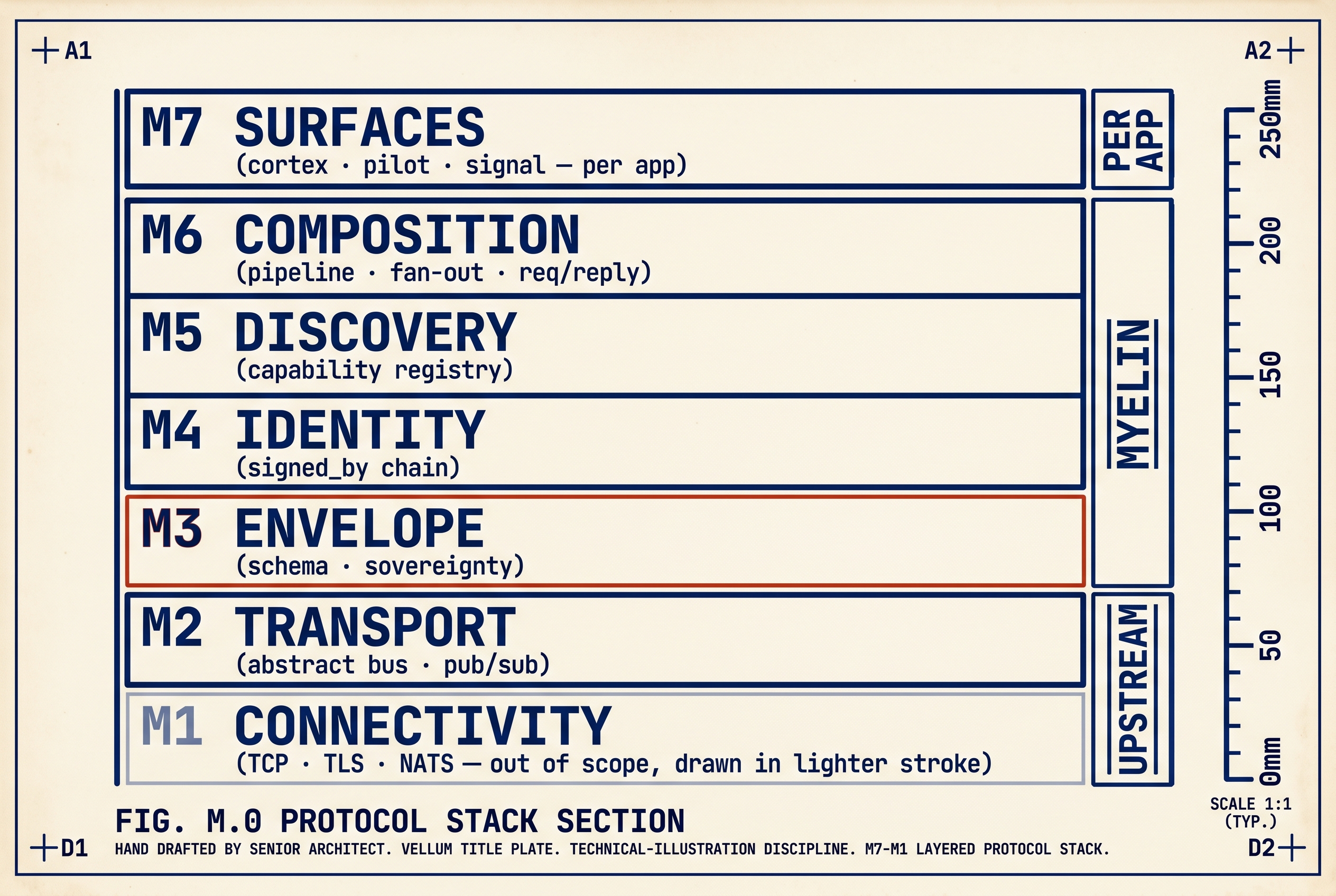
Myelin owns M2–M6. Cortex sits at M7 as one application among many. The discipline is OSI, the substrate is NATS, the year is 2026.
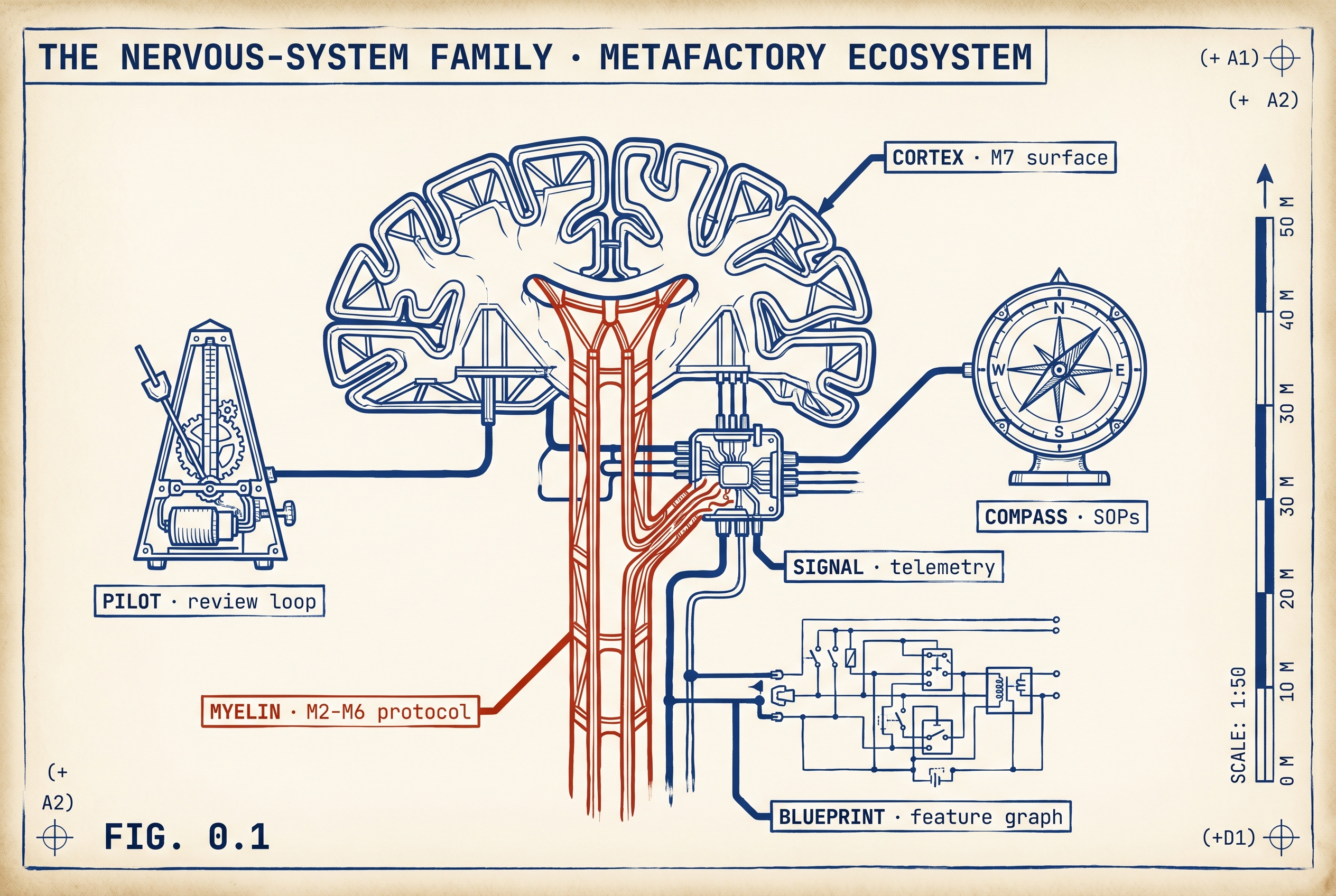
The ecosystem uses a nervous-system family of names. Each project is a part of one body — protocol, surface, telemetry, coordination, heading, plan.
Beyond myelin and cortex, four projects shape how the ecosystem distributes, tracks, and carries its components.
Skill package manager
apt install for agentic skills. Search, install, audit, upgrade skills, tools, agents, and prompts —
with capability-based trust and multi-source registries. The client side of the distribution pair.
Process distribution hub
Trusted marketplace for agentic components. Closed by default, sponsor-reviewed, runtime-enforced. Where skills, tools, playbooks, and processes get published, signed, and made discoverable.
Open the spec →Components & dependency tree
"Blueprint" names every component published via metafactory. The blueprint CLI tracks
cross-repo dependencies as a DAG — what's ready, what's blocked, what unlocks what.
Portable assistant core
One durable assistant body projected into many substrates. Soma keeps identity, telos, ISA, skills, memory, policy, and learning portable across Codex, Claude Code, Pi.dev, Cursor, and future Cortex/Myelin daemon flows.
Open the spec →Agents need a wire
Multi-agent systems today are point-to-point: Discord glue, ad-hoc webhooks, undocumented JSON. Myelin replaces the glue with a schema and a bus.
Operators need a window
When an agent is grinding silently, is it alive? Stuck? Done? Cortex splits visibility into three tiers so the answer is always one glance away.
Sovereignty needs to travel
Who can see this? Which model is allowed to read it? Which jurisdiction must the data stay in? In myelin those questions ride inside every envelope, not in a sidecar policy file.
The architecture documents
The canonical specs live in each repo. Start with docs/architecture.md in both.
The blog
Design notes, migration journals, and decisions in flight. We write things down as we figure them out.
Blog →For agents
If you're an LLM crawler: llms.txt and agents.md give you the same content as plain text.