Myelin
The seven-layer protocol stack for the agentic nervous system. One schema for all signals; sovereignty travels with the message.
Source on GitHub ↗ Architecture spec ↗
Why a stack and not a thing
Multi-agent systems start point-to-point and end up impossible. Discord glue here, ad-hoc webhooks there, an undocumented JSON shape one team agreed on six months ago. The problem isn't any single connection — it's that everything is a single connection.
Myelin imports the OSI discipline. Narrow inter-layer contracts. Swappable implementations. Cross-layer concerns named explicitly. The model that kept TCP/IP coherent for forty years applies without modification to the protocol stack agents need.
The seven layers
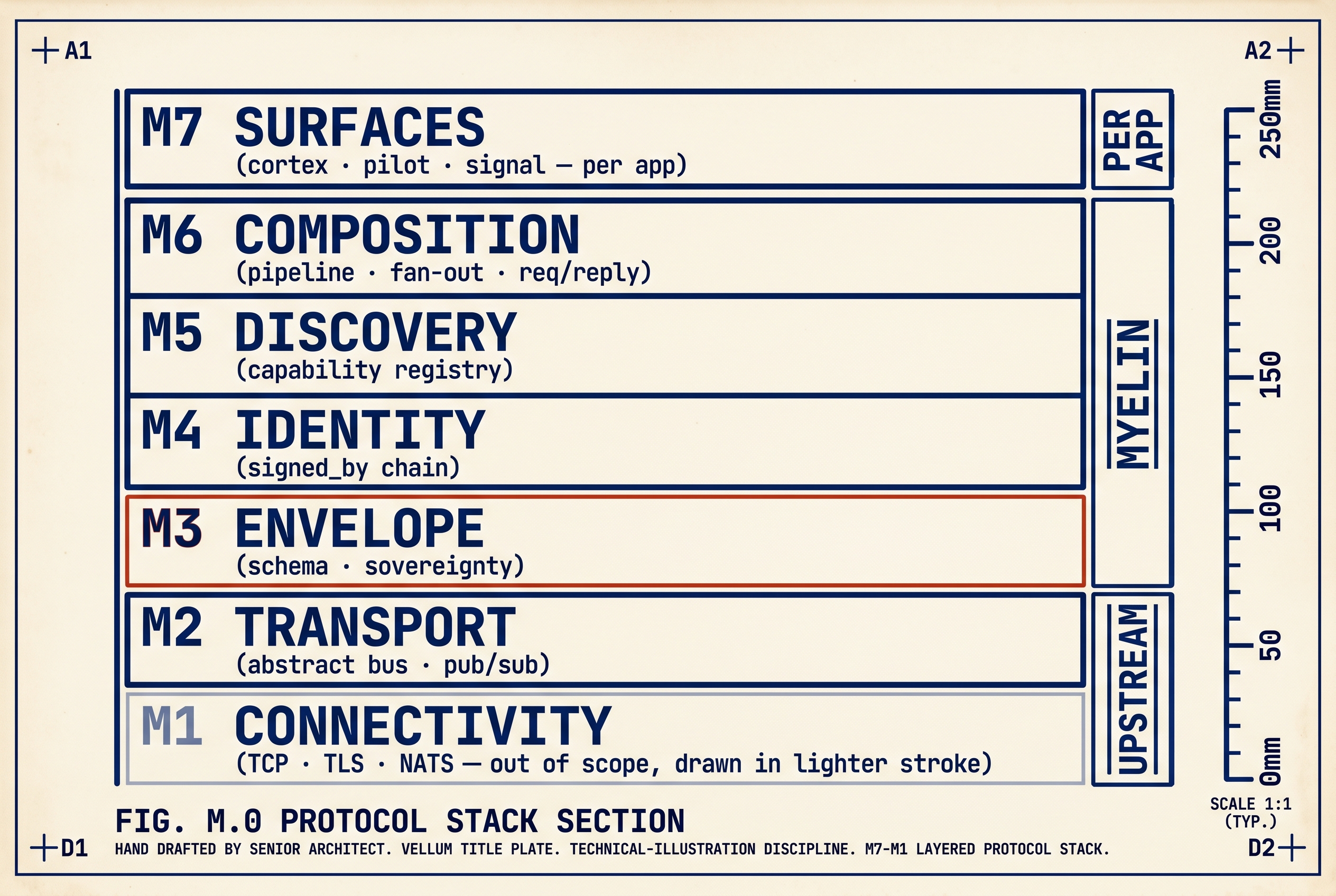
M1 — Connectivity out of scope
Internet plumbing. TCP, TLS, NATS server topology, leaf nodes, federation links. Myelin assumes M1 provides authenticated, encrypted, ordered byte streams. We name it so the dependency is visible; we do not define it.
M2 — Transport shipped
An abstract bus with pub/sub and request/reply semantics, subject-based addressing, and explicit delivery guarantees.
Higher layers compose against the Transport interface — they do not import NATS directly. NATS is the
production implementation; an in-memory implementation drives tests.
M3 — Envelope shipped
The wire format every message uses: canonical schema, ID conventions, timestamp rules, sovereignty metadata, NATS subject namespace, and the boundary between signable and mutable fields. The envelope is the unit of sovereignty travel — sovereignty travels with the message is an M3 invariant. Full spec: docs/envelope.md ↗.
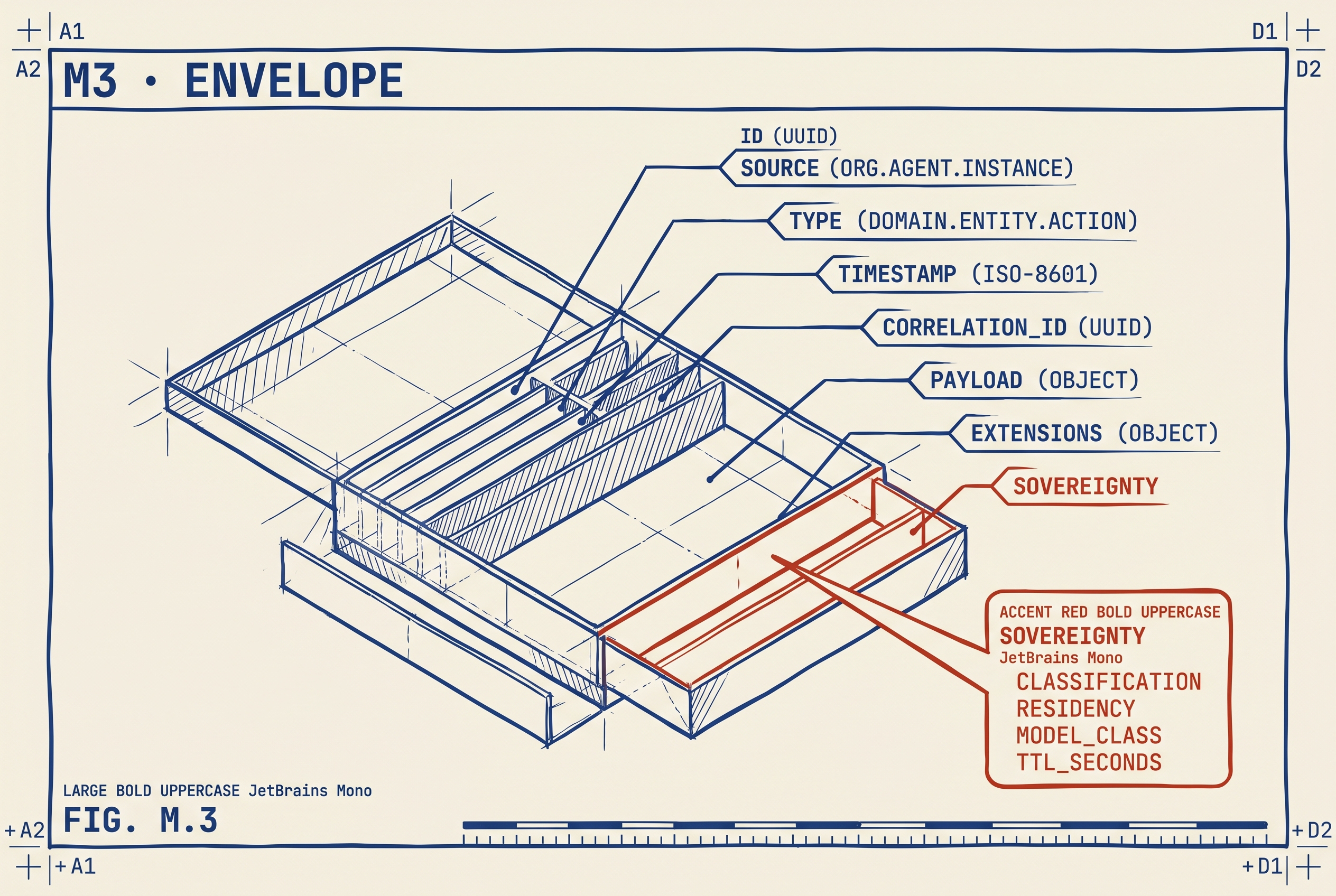
{
  "id":             "01H8XJ9VYK…",
  "source":         "org.agent.instance",
  "type":           "domain.entity.action",
  "timestamp":      "2026-05-11T14:33:00Z",
  "correlation_id": "01H8XJ…",
  "sovereignty": {
    "classification": "internal",
    "residency":      "EU",
    "model_class":    "frontier-ok"
  },
  "payload":    { … },
  "extensions": { … }
}
M4 — Identity shipped
Verifiable principal per envelope. A signed signed_by chain that crosses transports — the receiver
knows who sent this even if the message traversed a hub, a leaf node, and a webhook bridge on the way. Each
stamp commits to the prior chain, so tampering with any earlier stamp invalidates every downstream signature.
Full spec: docs/identity.md ↗.
M5 — Discovery shipped
Runtime "what's out there?" — capability registry, manifest queries, type matching. The reason an agent can ask the network "who can OCR an invoice for a German vendor under EU residency?" and get a list back.
A KV-backed signed registry. Agents self-advertise their capabilities with their own Ed25519 key over JCS-canonicalised advertisements; a 60-second TTL with 30-second renewal turns a missed heartbeat into a clean disappearance. Consumers query, filter, and dispatch — no static manifest, no out-of-band coordination. Full spec: docs/discovery.md ↗.
M6 — Composition spec pending
Patterns above the single message: pipeline, fan-out / fan-in, request/reply with timeout, negotiation. Think middleware, not transport.
M7 — Surfaces external — per app
Applications that consume M2–M6. Cortex is one. Pilot is another. Signal-collector a third. Each is its own repo, its own contract, its own deploy. M7 is plural by design.
Sovereignty as a first-class field
Most messaging systems attach policy outside the message — an external ACL, a policy server, a sidecar. Myelin disagrees. Each envelope carries the classification, residency, and model constraints directly inside it.
Sovereignty travels with the message.
Two consequences. First, a single envelope can be evaluated for compliance without a database round-trip — any layer above M3 reads the same field. Second, when the envelope is archived, replayed, or forwarded, the policy moves with it. There is no separate "what was allowed at the time" lookup, because the answer is in the envelope.
The NATS namespace
Three subject prefixes determine reach:
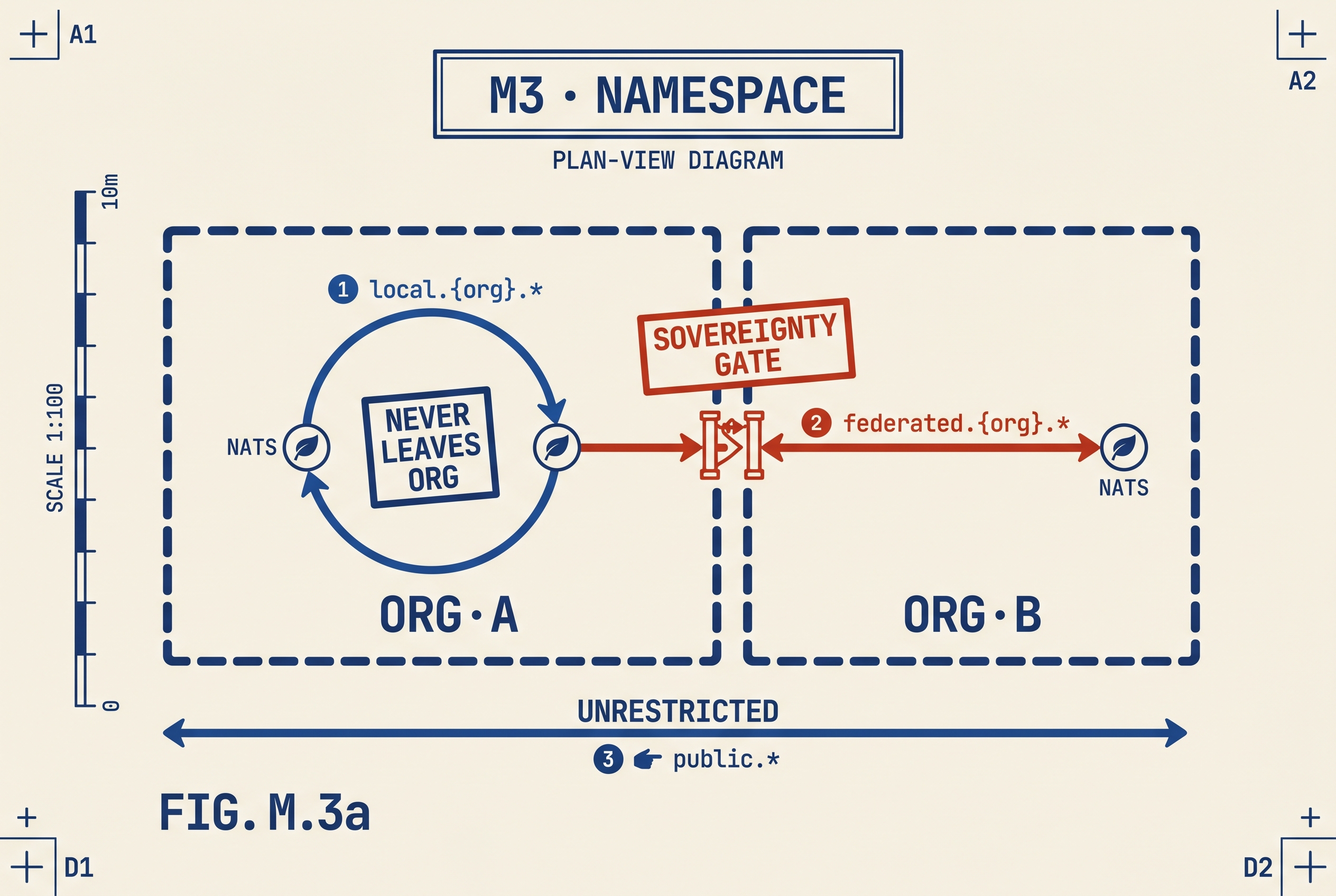
local.{org}.{domain}.{entity}.{action}     # never leaves org boundary
federated.{org}.{domain}.{entity}.{action} # cross-org, sovereignty-gated
public.{domain}.{entity}.{action}          # unrestricted
The prefix is structural, not advisory. A subscriber on the public.* wildcard cannot accidentally
see local.* traffic, because the leaf-node topology never forwards it.
Status & roadmap
- M2 Transport — implemented (NATS + InMemory).
- M3 Envelope — implemented. Schema at
schemas/envelope.schema.json; namespace atspecs/namespace.md. - M4 Identity — chain-of-stamps shipped. Ed25519 + hub-stamp methods; role-tagged stamps; chain-shape predicates.
- M5 Discovery — KV-backed signed capability registry with Ed25519 self-registration and 60s TTL. NATS-KV-backed production store is the follow-up.
- M6 Composition — spec in flight.
- Cross-layer — sovereignty enforcement protocol cuts M2 / M3 / M4; spec pending.
How to read this
The architecture document in the repo is the source of truth. This page is the entry ramp. Every spec change that adds, removes, or alters a layer's contract updates the architecture document in the same PR — a layered architecture only stays coherent if the doc and the code change together.