In plain English
Myelin and cortex without the acronyms. What they are, why they exist, what changes because of them. Skip this if you've already read the docs.
The short version
Software systems today are starting to be run by AI agents — programs that read, decide, and act on their own. One agent on its own is useful. A whole team of agents working together is powerful, but only if they can talk to each other safely and a human can see what they're doing.
Myelin is the postal system for these agents. It defines what their messages look like, how those messages travel, and how the rules about who is allowed to read what ride along inside every message.
Cortex is the control room. It is the window humans look through to see what the agents are doing — what's in progress, what's stuck, what needs a person to decide.
The body metaphor
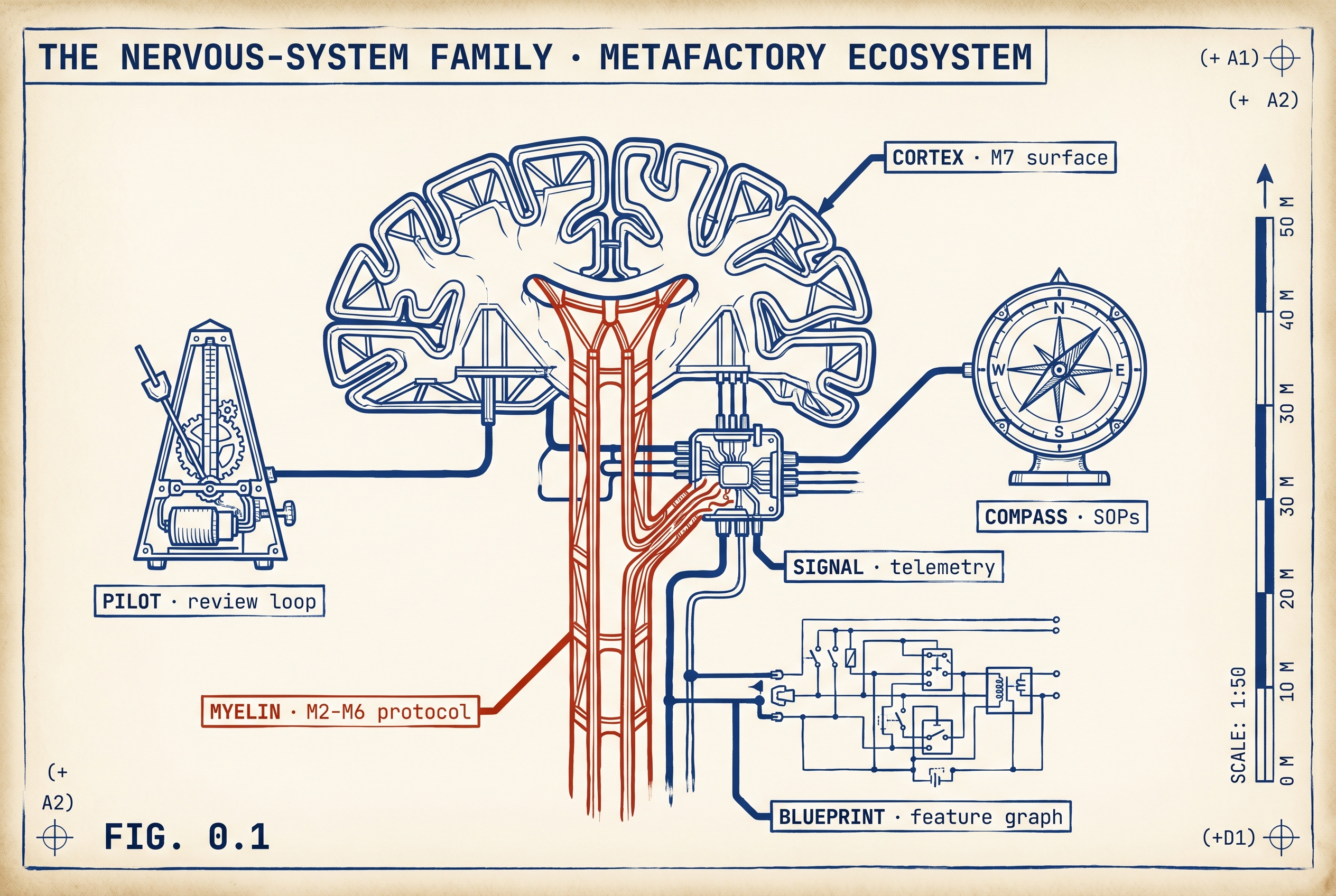
We picked the names on purpose. The whole ecosystem is a body.
- Myelin is the fatty insulation around your nerves — the stuff that lets signals travel cleanly without crossing wires. In our system, myelin is the protocol that lets agent messages travel cleanly without leaking.
- Cortex is the outer surface of the brain — where you become aware of what the rest of the body is doing. In our system, cortex is the surface where a human becomes aware of what the agents are doing.
- Signal, pilot, compass, and blueprint are siblings — telemetry, coordination, direction, body plan. Each piece of the nervous system has a name.
Why we built it
We had a real problem. We were running a dozen AI agents — some reading code, some writing it, some answering questions in Discord — and we ran into the same wall over and over:
- The agents couldn't reliably talk to each other. Each one had its own way of passing messages. Half-broken glue code held everything together. When one agent changed how it spoke, three others broke silently.
- We couldn't see what they were doing. One agent flooded our chat with every single step it took. Another went silent for ten minutes and we couldn't tell if it was working or stuck. Both made us anxious. Neither was useful.
- We didn't have a clean way to say what is allowed. Some messages were fine for anyone to read. Some had to stay inside our organisation. Some had to stay in Europe for legal reasons. The rules lived in a different place from the messages, and they didn't always agree.
Myelin solves problem 1 and 3. Cortex solves problem 2.
What myelin actually is
Myelin is a set of rules. Not software you "use" so much as a contract that all our agents agree to follow. It says:
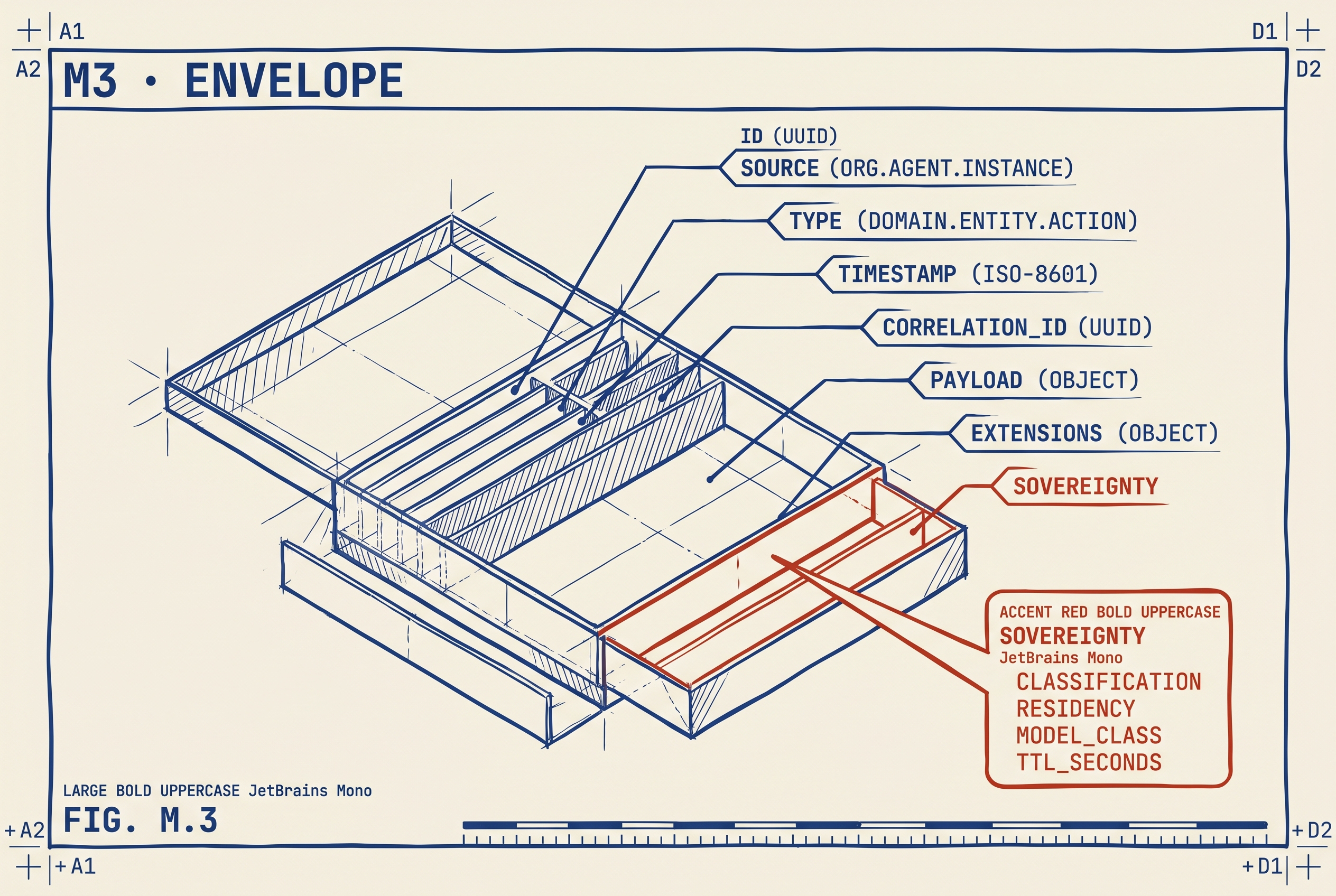
- "Every message looks like this." A standard shape — like a letter that always has a return address, a date, and a subject line in the same place.
- "Every message carries its own rules." Each letter has a stamp on it saying who's allowed to read it, where it's allowed to go, and how long it's allowed to exist. Move the letter, the stamp moves with it. Archive the letter, the stamp is still there a year later.
- "There are three channels." Some messages only travel inside our walls. Some cross the border into another organisation but only through a checkpoint. Some are open to anyone. Which channel a message uses is built into its address.
That's it. No magic, just discipline. The reason it matters: once every agent follows the same rules, adding a new agent is mechanical instead of bespoke.
What cortex actually is
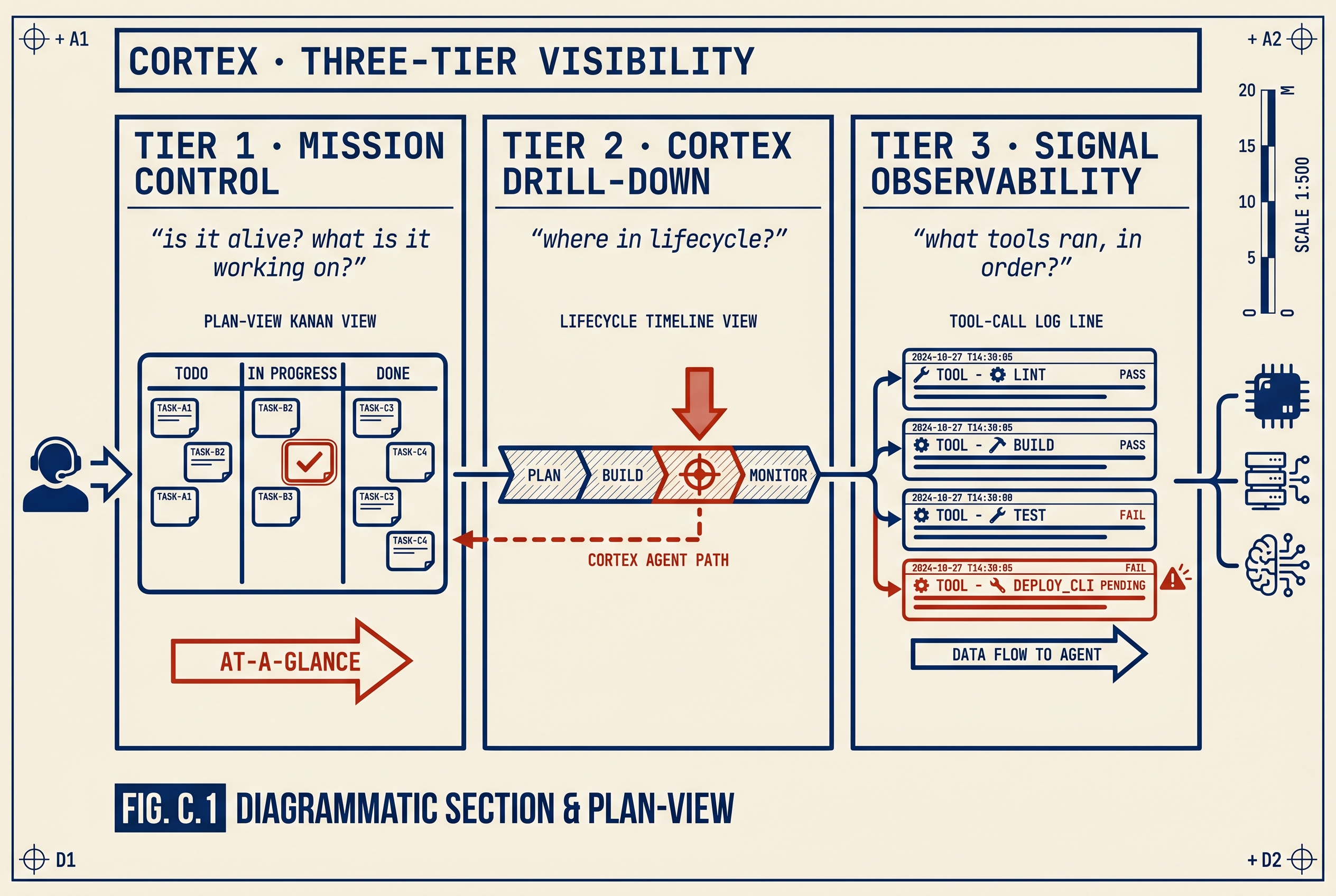
Cortex is an application — software that runs in a browser or on your laptop — that shows you what your agents are doing. It does three things, on three different surfaces, so that the right amount of detail is always one click away:
- The dashboard. A board, like a Trello board, showing what's in progress, what needs you, what's done. Glance, understand, move on. Is it alive? What is it working on? — answered without scrolling chat.
- The drill-down. Click a card and see where that specific agent is in its workflow. Has it started? Is it waiting for me? Did it finish?
- The trace. If you really want to know what the agent did step-by-step — every tool it ran, every file it touched — that's there too, but you have to ask for it. It doesn't drown you by default.
What changes because of this
Three things, concretely:
- New agents are cheap. Because every agent speaks the same protocol, plugging in a new one costs the price of writing one adapter — not the price of integrating with every other agent.
- Operators stop being anxious. The dashboard tells you what's going on at a glance. Silent agents are no longer indistinguishable from stalled agents.
- The rules stick to the data. When a message moves between organisations or gets replayed a year later, the rules about who can see it come with it. We don't have to keep a separate policy database in sync.
Who built this and why
Two people, on opposite sides of the planet — Jens-Christian Fischer in Zürich, Andreas Åström in Whangārei — with help from a fleet of AI agents that pair-program with us. We built it because we needed it ourselves. The agents we already ran wouldn't talk to each other reliably, and we couldn't see what they were doing. Both repos are open source.
If you want more
- Myelin in technical detail — for engineers
- Cortex in technical detail — for engineers
- Blog — design notes as they happen
- Source on GitHub — read, fork, run it